We had a wonderful couple of days in Córdoba.
The high speed train from Madrid to Toledo takes less than a half hour, giving us the day to go through the El Greco Museum and the Cathedral.
“The Holy Church Cathedral is dedicated to Virgin Mary in her Ascension to the heavens. Its construction began in 1227 under order of the Archbishop Don Rodrigo Jiménez mandate. The site was situated over the foundations of the Visigoth Cathedral in the sixth century, which had been used as a Mosque. Constructed in a Gothic style with a French influence, it measures 120 m long by 60 m wide and contains 5 naves supported by 88 pillars and 72 vaults. The side naves are extended behind the Main Chapel surrounding the presbytery and this creates an apse aisle with a double semicircular corridor.” http://www.catedralprimada.es/index.php
We got to visit Barcelona from March 16 – 19.
The Sovereignty Dispute over the Falkland (Malvinas) Islands
Lowell Gustafson
Department of
Political Science
Villanova University
Villanova, PA 19085
| Who has the Legal Title, the Rightful Claim to the Islands? |
||||||
| Political Geography | ||||||
| 51o42’S, 57o51’W; | ||||||
| 12,173 km2, 4,700 sq miles; | ||||||
| 300 miles (480)km east of Argentina in South Atlantic |
||||||
| Political Nomenclature | ||||||
| Falkland Islands or Falklands, Las Islas Malvinas or Malvinas, Falklands / Malvinas, Falklands (Malvinas) |
||||||
Discovery: Sightings and Landings |
||||||
Indigenous Discovery and Settlement? The Yaghan people? |
||||||
| European Sightings of the Islands |
||||||
| Amerigo Vespucci, Estaban Gomez of Ferdinand Magellan Simon de Alcazaba, |
||||||
| Francisco de Camargo | ||||||
| John Davis, Richard Hawkins | ||||||
| Sebald van Weerdt | ||||||
| John Strong | ||||||
| Discovery and Possession |
||||||
| Papal Grant
|
||||||
| Pope Alexander VI, 1493 | ||||||
| Treaty of Tordesillas, 1494 | ||||||
| England and the Spanish Empire |
||||||
| Search for naval base from which to penetrate Spanish Empire in South America, support the independence of Spanish American colonies |
||||||
| French attempt to restore its empire |
||||||
| Antoine Louis de Bougainville founds Port St. Louis in Les Malouines in January 31, 1764France pays Bougainville for the settlement, Port St. Louis ceeded to Spain in 1767 |
||||||
| British Settlement |
||||||
| – John Byron, January 4, 1765 founds Port Egmont, after the French settlement was founded. |
||||||
| – Spanish forcibly evict the British settlement in 1769 |
||||||
| – Some British, such as Lord Chatham, favor forcible response to restore British control of Port Egmont if necessary |
||||||
| – Did Lord North think that Falklands were in fact not valuable enough to warrant conflict with Spanish, but was unable to publicly back down to Spanish for domestic political reasons? Was there a Secret Agreement between North and the Spanish that if the Spanish returned Port Egmont to the British now, Britain would leave these unimportant islands within a brief time after the dust settled? |
||||||
| – Britain does vacate Falklands in 1774, but leaves a plaque asserting British claim to the islands. |
||||||
| – Nootka Sound Convention of 1790 | ||||||
| Political Independence of Argentina |
||||||
| 1810 establishment by Cabildo of the Primera Junta in support of Ferdinand VII |
||||||
| Britain still interested in penetrating Spanish empire |
||||||
| Lord Beresford’s old style military approach to colonialism |
||||||
| Encouragement of Latin American political independence, economic neo-colonialism |
||||||
| Spain preoccupied by independence movements on mainland, in 1811 the Spanish abandon Las Islas Malvinas |
||||||
| Principle of Uti Possidetus vs. post-independence political fragmentation: which territories of old vice-royalties will become parts of newly independent nations? |
||||||
| Sealers, fisherman of various nationalities informally use the Falklands |
||||||
| – Argentina attempts to establish de facto and de jure control over Las Malvinas.Louis Vernet.– 1825 Treaty of Amity, Commerce, and Navigation between Great Britain and Argentina. – – – – – – |
||||||
| Summary: Discovery, Settlement, Abandonments, Plaques, Fishing, and Conquest |
||||||
| Superiority of Argentine Historical Claims before 1833 |
||||||
Self-Determination, Decolonization, and a New Just War? |
||||||
| The Principle of Self Determination: Who is the Self? What may it determine? |
||||||
| – The Falkland Islanders (kelpers) who live on a well defined piece of territory should be permitted to decide their political affiliation.- Is the self an individual who makes personal choices?– Is the self an entire nation, a people who together or as represented by a democratic government may decide what territory is to be included under its sovereignty. In this case, all of Britain is the self, with Falklanders a small percentage. |
||||||
| Decolonization and the Use of Force |
||||||
| – To prevent future first uses of force in the drawing of boundaries, should borders previously drawn through the use of force be accepted?- Anti-colonialists argue that what the imperialists after WWII called the first use of force in opposition to established colonies will not lead to WWIII; instead anti-colonial use of force is in self-defense against aggression of previous centuries.– Colonized peoples seek to gain independence: Unification of self-determination and decolonization: justifies the (defensive) use of force of anti-colonialists. – A new just war doctrine accepts anti-colonial aggression.1960 U.N. – 1961 Indian invasion of Portuguese Goa, which had been there for – U.N. General Assembly Resolution 2065: apply 1514 to Malvinas. – African and Asian independence movements largely complete by – By 1982, many former anti-colonists who had supported Indian |
||||||
I had the opportunity to visit Rome from January 30 to February 3, 2017 with a class led by Dt. José Ángel Agejas, who earned his PhD at the Pontifical Gregorian University in Rome. (I’m keeping these pictures from Rome in my Spain category; they were taken on a trip organized by Francisco de Vitoria in Spain.)
The first church we visited was Santa Maria in Vallicella. “St. Gregory the Great built the first church on the site. By the 12th century, it was dedicated to Santa Maria in Vallicella (“Our Lady in the Little Valley”).
We then went to the church of Santa Pudenziana, which may be the oldest place of Christian worship in Rome. It was built over a 2nd-century house, probably during the pontificate of Pius I in 140–155 AD, and re-uses part of a bath facility still visible in the structure of the apse. This church was the residence of the Pope until, in 313, Emperor Constantine I offered the Lateran Palace in its stead. In the 4th century, during the pontificate of Pope Siricius, the building was transformed into a three-naved church. In the acts of the synod of 499, the church bears the titulus Pudentis, indicating that the administration of the sacraments was allowed.
San Pietro in Vincoli is not very imposing on the outside. But it is where Michaelangelo’s Moses is held.
The Basilica di San Bartolomeo all’Isola was built in the tenth century over the Roman Temple of Aesculapius. It is said to hold the remains of Saint Bartholomew. It also holds relics of many martyrs from the 20th and 21st centuries, such as the Bible read by Archbishop Romero of El Salvador when he was killed in 1980; a relic of Father Jacques Hamel, who was killed at a church in Normandy, France in July of 2016.
Basilica di Santa Prassede all’Esquillino was commissioned by Pope Hadrian I around the year 780, and built on top of the remains of a 5th-century structure and was designed to house the bones of Saint Prassede and Saint Pudenziana, the daughters of Saint Pudens, traditionally St. Peter’s first Christian convert in Rome. The two women were murdered for providing Christian burial for early martyrs in defiance of Roman law. The basilica is well known for its mosaics.
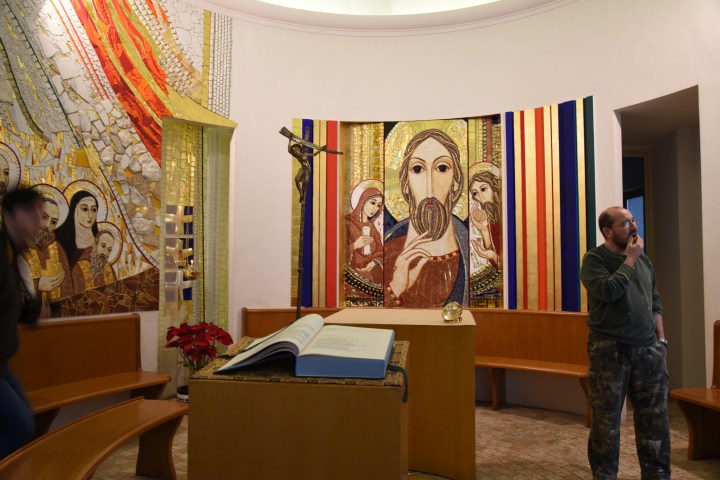
The Pontifico Istituto Orientale; Centro Studi e Ricerche Ezio Aletti is a workshop where contemporary mosaics are made. It is planning to produce a new chapel at the Universidad Francisco de Vitoria.

Chiesa Di Sant Ignazio di Loyola in Campo Marzio is a Counter Reformation style that exuberantly displays angels, saints, and all kinds of mystical beings. It is also the resting place for the Saint’s bones.
Contarelli Chapel holds three paintings on Saint Matthew by the Baroque painter Caravaggio.
San Pietro in Montorio was built on the site of an earlier 9th-century church dedicated to Saint Peter on Rome’s Janiculum hill. According to tradition, it was the site of his crucifixion. The Tempietto (“small temple”) is a small commemorative tomb built by Donato Bramante, in about 1502. It is meant to mark the traditional exact spot of St. Peter’s martyrdom, and is a precursor to Bramante’s rebuilding of St. Peter’s. It influenced the building of many other domes, including that over the US Congress.
Basilica Di San Clemente al Laterano is dedicated to Pope Clement I. There is: (1) the present basilica built just before the year 1100; (2) beneath the present basilica is a 4th-century basilica that had been converted out of the home of a Roman nobleman, part of which had in the 1st century briefly served as an early church, and the basement of which had in the 2nd century briefly served as a mithraeum (a temple dedicated to the Roman God Mithras); (3) the home of the Roman nobleman had been built on the foundations of republican era villa and warehouse that had been destroyed in the Great Fire of 64 AD.
I got to be in Spain for the spring of 2017, where I taught at Francisco de Vitoria University. I lived in Madrid.
One thing that makes Francisco de Vitoria impressive was his response to indigenous Americans in the Spanish Empire. A bit of a fanciful comparison might be thinking about how we would respond if we actually did discover new life forms on a planet in another solar system. No one was expecting new continents between Europe and Asia, much less any new types of cultures. Was this Asia or new land? Were they people? If so, did they have souls or rights? His book on this remains worth reading.
Then, in June I had the chance to visit South Korea at the invitation of the Korean Big History Academy.
Recent Comments